Disaster Government: National Emergencies, Continuity of Government and You by Brian Tuohy
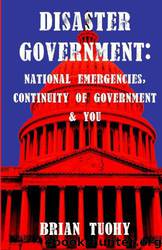
Author:Brian Tuohy [Tuohy, Brian]
Language: eng
Format: epub, mobi
ISBN: 9780988901100
Amazon: 0988901102
Publisher: Mofo Press LLC
Published: 2013-01-24T05:00:00+00:00
Posse Comitatus
The question that immediately follows becomes is it legal for the military—that being the Army, Navy, Air Force, Marines, or some unit contained within those branches—to operate within the borders of the United States? The answer is simple: yes. As written in the Joint Chiefs of Staff Joint Publication 3-26 titled “Counterterrorism,” “The President has the authority to direct the use of the military against terrorist groups and individuals in the United States for other than law enforcement actions (i.e., national defense, emergency protection of life and property, and to restore order).” The reason the “other than law enforcement” distinction is made is due to the notion of “posse comitatus,” a term and idea in need of clarification.
Translated from its original Latin, posse comitatus literally means, “Attendants with the capacity to act,” but has taken the meaning, “The power (or force) of the country.” In essence, it is the use of the military by the government as a police force over the citizens they are charged with protecting. The Posse Comitatus Act, officially known as 18 U.S.C. 1385, was an outgrowth of the reconstruction period following the Civil War. After the Union had been reunited, the federal government stationed army troops in the Southern states to maintain civil order, oversee elections, and generally quash any lingering Confederate sentiments. Once order and peace were achieved, some members of Congress (mainly Southerners) worried that the Army was acting outside of its original intent. To eliminate those fears, the Posse Comitatus Act passed in 1878. This was not a constitutional right—nor based upon one—but rather a simple act of Congress. Today this law reads much like it did when originally passed: “Whoever, except in cases and under circumstances expressly authorized by the Constitution or Act of Congress, willfully uses any part of the Army or the Air Force as a posse comitatus or otherwise to execute the laws shall be fined under this title or imprisoned not more than two years, or both.” What the act did, and what it was intended to do, was to prevent the military from acting as a police force, especially a private one for the likes of a power mad general or president. It never was to completely stop the military from operating within the borders of the United States.
Even though it was a congressional act, the Posse Comitatus Act has several exceptions. The primary one is that two branches of the military do not have to adhere to it. The first is the U.S. Coast Guard. While the Coast Guard performs a variety of services, one of its main tasks is to curb criminal violations, a power it was granted via a direct act of Congress. The other military branch is the National Guard. The National Guard operates under a separate set of laws (Title 32 of U.S. Code) from its brethren in the other military branches (Title 10, though the Coast Guard operates under Title 14). As such, the National Guard is free from posse comitatus restrictions.
Download
Disaster Government: National Emergencies, Continuity of Government and You by Brian Tuohy.mobi
This site does not store any files on its server. We only index and link to content provided by other sites. Please contact the content providers to delete copyright contents if any and email us, we'll remove relevant links or contents immediately.
The Secret History by Donna Tartt(19035)
The Social Justice Warrior Handbook by Lisa De Pasquale(12183)
Thirteen Reasons Why by Jay Asher(8885)
This Is How You Lose Her by Junot Diaz(6873)
Weapons of Math Destruction by Cathy O'Neil(6261)
Zero to One by Peter Thiel(5784)
Beartown by Fredrik Backman(5734)
The Myth of the Strong Leader by Archie Brown(5495)
The Fire Next Time by James Baldwin(5426)
How Democracies Die by Steven Levitsky & Daniel Ziblatt(5211)
Promise Me, Dad by Joe Biden(5141)
Stone's Rules by Roger Stone(5080)
A Higher Loyalty: Truth, Lies, and Leadership by James Comey(4947)
100 Deadly Skills by Clint Emerson(4917)
Rise and Kill First by Ronen Bergman(4776)
Secrecy World by Jake Bernstein(4739)
The David Icke Guide to the Global Conspiracy (and how to end it) by David Icke(4697)
The Farm by Tom Rob Smith(4501)
The Doomsday Machine by Daniel Ellsberg(4482)
